How to Use Tyre Inflator: The Correct Method
Learning how to use tyre inflator is straightforward, but the important part is not simply connecting the pump and adding air. You need to use the vehicle manufacturer's recommended pressure, connect the inflator securely to the valve, monitor the reading while air is being added, and verify the final pressure when finished. The same basic process works whether you are using a portable tyre inflator at home, a digital air compressor, a manual pump, or a machine at a petrol station.
The correct tyre pressure comes from your vehicle, not from the maximum PSI printed on the tyre sidewall. That recommended value is normally shown on the driver's door-jamb or door-frame label and in the vehicle owner's manual. Tyre pressure should preferably be checked when the tyres are cold because driving heats the tyre and changes the pressure reading.

Important: A tyre inflator is designed to add air or measure pressure. It is not a repair for a damaged tyre, puncture, leaking valve, sidewall damage, or structural tyre failure. If a tyre repeatedly loses pressure, simply topping it up is not a complete solution.
What You'll Learn
- How to use a tyre inflator correctly without overinflating the tyre.
- How to use a digital, manual, portable, cordless, or petrol-station inflator.
- How to check pressure using PSI, bar, and a built-in gauge.
- What to do when a tyre is already warm from driving.
- When a low-pressure tyre can be inflated and when it needs professional inspection.
- How to avoid the common mistakes that cause inaccurate tyre pressure.
Check the Correct Tyre Pressure Before You Start
Before you switch on any compressor, find the correct pressure for your vehicle. Look at the tyre-pressure label on the driver's door area, inside the fuel flap where applicable, or in the owner's manual.
Do not automatically use the number molded into the tyre sidewall as your target pressure. That figure is generally the tyre's maximum permitted inflation pressure, not necessarily the pressure your vehicle manufacturer recommends for normal driving.
- Check whether your vehicle uses PSI, bar, or kPa.
- Check whether the front and rear tyres require different pressures.
- Check the correct pressure for your vehicle's normal or loaded condition.
- Include the spare tyre in your regular pressure checks where one is fitted.
For reference, 1 bar is approximately 14.5 PSI. Many petrol-station machines and portable inflators allow you to select either measurement, so choose the unit that matches the vehicle manufacturer's recommendation.
How to Use a Tyre Inflator With Gauge
If your inflator has a built-in pressure gauge, the process is simple. First remove the valve cap, attach the inflator connector firmly to the valve stem, and look at the pressure reading before adding air.
- Park safely. Switch off the vehicle and secure it on a stable surface.
- Remove the valve cap. Keep it somewhere clean so it does not disappear or collect dirt.
- Attach the inflator. Push or screw the connector onto the valve stem according to the design of your pump.
- Check the current pressure. Read the gauge before inflating.
- Set the target pressure. If your model has digital controls, enter the recommended PSI or bar value.
- Start inflating. Add air while watching the gauge or display.
- Stop at the correct pressure. Do not continue pumping simply because the compressor is still running.
- Recheck the reading. Disconnect and measure again if the connector or gauge design makes the reading uncertain.
- Replace the valve cap. Repeat the process for the remaining tyres.
The final pressure matters more than how quickly you inflate the tyre. Adding air in short periods and checking the reading gives you more control, especially with simple analogue pumps that do not have an automatic shut-off function.
How to Use a Digital Tyre Inflator
Digital inflators remove much of the guesswork because you can usually select the target pressure directly on the display. Many current models also provide automatic shut-off when the programmed pressure is reached.
- Turn on the digital inflator.
- Select PSI, bar, or kPa according to the pressure specification you are using.
- Set the required target pressure.
- Connect the hose securely to the tyre valve.
- Start the compressor.
- Watch the display while the pressure rises.
- Allow the automatic shut-off to stop the compressor if the model provides that function.
- Check the tyre again after disconnecting the hose if necessary.
Digital displays are convenient, but convenience does not automatically mean perfect accuracy. A built-in gauge can drift or disagree with another gauge, so a separate accurate pressure gauge can be useful when precise pressure matters.

How to Use Tyre Inflator at Petrol Station
Knowing how to use tyre inflator at petrol station is especially useful when you notice a low-pressure warning while away from home. Most forecourt air machines have a pressure gauge and a way to select the target pressure.
- Park close enough for the hose to reach each tyre safely.
- Find the recommended tyre pressure from your vehicle's label or manual.
- Set the machine to the required PSI or bar.
- Remove the valve cap from the tyre.
- Connect the machine's inflation head firmly to the valve.
- Wait while the machine adds or releases air according to its design.
- Check the displayed pressure.
- Disconnect the hose and replace the valve cap.
- Repeat for every tyre, including the spare if accessible.
Do not assume every petrol-station gauge is perfectly calibrated. A station machine can be convenient for getting a tyre back to the correct range, but checking pressure periodically with a known-accurate gauge adds confidence.
Some forecourt machines offer separate controls for increasing or decreasing pressure, and some provide a rapid-fill mode for significantly underinflated tyres. The exact controls vary, so follow the instructions displayed on the machine instead of guessing.
How to Use Tire Inflator at Gas Station
The American term tire and the British spelling tyre refer to the same component, so how to use tire inflator at gas station follows the same fundamental process as using an inflator at a petrol station.
Find the manufacturer's recommended pressure, set the machine to that value, attach the hose firmly, inflate, verify the result, and replace the valve cap. The location changes; the pressure-setting principle does not.
How to Use Tire Inflator at Home
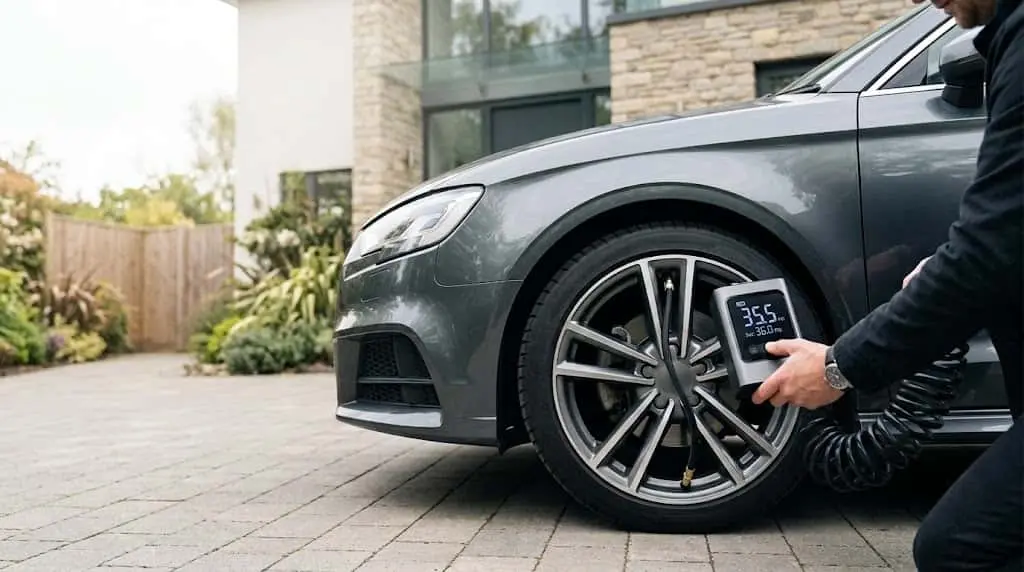
A home setup is usually easier because you can take your time and work on cold tyres. A portable tyre inflator, 12V compressor, rechargeable cordless pump, or suitable foot pump can all be useful depending on your needs.
- Park the vehicle in a safe, reasonably level place.
- Let the tyres cool after driving.
- Read the recommended pressure from the vehicle label or owner's manual.
- Power the inflator according to its instructions.
- Attach the air hose to the first valve.
- Measure the starting pressure.
- Add air until the target pressure is reached.
- Remove the connector carefully and replace the valve cap.
- Repeat on the other tyres.
Home inflation is particularly useful because you can check the tyres before starting a journey rather than reacting to a low-pressure warning after driving. For routine maintenance, pressure checks are generally recommended at least monthly and before longer trips.
How to Use Portable Air Pump for Car Tires
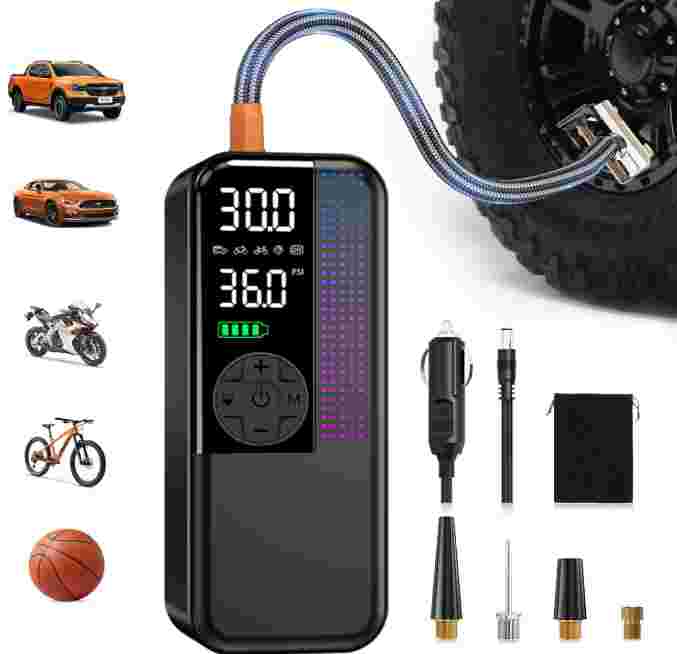
A portable air pump for car tyres normally contains a small compressor, an air hose, a valve connector, a pressure display or gauge, and a power source. Some models connect to a 12V vehicle socket, while others use a rechargeable battery.
The basic workflow is:
- Place the compressor somewhere stable.
- Connect its power source.
- Connect the air hose to the tyre valve.
- Read the existing pressure.
- Set the desired pressure if the pump supports presets.
- Start the compressor.
- Stop at the correct pressure.
- Disconnect and replace the valve cap.
Portable compressors are best viewed as a maintenance and emergency convenience rather than a substitute for professional tyre repair. A compressor can restore pressure, but it cannot correct a puncture, damaged valve, sidewall defect, or mechanically damaged wheel.
How to Use Tyre Inflator for Car: Complete Process
If you are searching for how to use tyre inflator for car, the following sequence covers the complete job from preparation to final inspection.
Step 1: Park safely
Choose a stable location away from moving traffic where possible. Keep the compressor, cable, and hose away from hot engine components and moving parts.
Step 2: Find your pressure specification
Use the vehicle placard or owner's manual. Record the front and rear values if they differ.
Step 3: Inspect the tyre
Look for obvious cuts, bulges, embedded objects, severe tread damage, or a visibly distorted sidewall. Inflation is not the right response to every tyre problem.
Step 4: Measure before filling
Attach the gauge or inflator and note the starting pressure. This tells you how much air is missing and helps identify a tyre that is losing pressure unusually quickly.
Step 5: Inflate gradually
Turn the compressor on and let it build pressure. If you are using a basic inflator without automatic shut-off, monitor the gauge yourself.
Step 6: Recheck the final pressure
Once the target is reached, verify the pressure. If the connector leaks slightly while being removed, take another reading and make a small correction if needed.
Step 7: Repeat across the vehicle
Do not stop after fixing the tyre that triggered the warning. Check the other tyres because pressure loss can occur across the set.
Step 8: Investigate repeated pressure loss
If the same tyre needs frequent top-ups, have it inspected for a puncture, valve problem, wheel issue, or other leak.
How to Use Tire Inflator With Gauge
An analogue gauge is still perfectly usable when you understand how to read it. The key is to make a firm connection to the valve so air does not escape around the connector during measurement.
- Remove the valve cap.
- Press the gauge head straight and firmly onto the valve.
- Read the needle once the pressure stabilizes.
- Compare the result with the recommended cold pressure.
- Inflate in short bursts.
- Measure again.
Do not blindly trust a reading that changes because the connector is poorly seated. A loose connection can hiss continuously and make you think the tyre or compressor has a problem when the real issue is simply the valve connection.
How to Use a Tyre Inflator Portable or Cordless
A cordless portable tyre inflator is convenient because it does not require a petrol-station compressor or a long extension cable. Current models commonly combine rechargeable batteries, digital pressure displays, automatic shut-off, and compact designs.
Before relying on a cordless inflator for a long journey, charge the battery and understand how much work the compressor can perform on a single charge. The advertised PSI rating describes maximum pressure capability, not necessarily how quickly the unit will inflate a particular car tyre.
- Charge the battery before trips.
- Store the hose and adapters together.
- Keep the unit accessible rather than buried under luggage.
- Learn the pressure-setting controls before an emergency.
- Test the compressor on your own tyres before depending on it roadside.
How to Use a Manual Tyre Inflator
A manual tyre pump works without an electrical motor. Depending on the design, it may be a foot pump or hand pump with a pressure gauge.
To use one, connect the pump head to the valve, lock it securely, pump the handle or foot pedal repeatedly, and periodically check the gauge. Manual pumps are slower than electric compressors, but they can be valuable when electrical power or battery charge is unavailable.
The main challenge with a manual pump is control. Pumping too quickly without watching the gauge can lead to overinflation, while a poor valve connection can waste effort without adding much air.
How to Use Tyre Inflator Kit
A tyre inflator kit can contain several items, such as an air compressor, hose, valve connector, pressure gauge, power cable, adapters, and sometimes a repair or sealant product.
Do not assume every item in the kit is intended for the same job. The compressor inflates the tyre; adapters may be intended for bicycles, sports equipment, or other inflatables; and a sealant cartridge has an entirely different purpose from normal air inflation.
- Identify the car-tyre connector.
- Check the power requirements.
- Read the pressure units.
- Confirm whether the unit has automatic shut-off.
- Keep unrelated adapters separated so they are not mistakenly used on the tyre valve.
How to Use a Tyre Inflator and Sealer
Inflator-and-sealer kits are designed for temporary emergency situations where a suitable sealant is used to reduce air loss from certain punctures before the tyre is driven to a repair location.
Sealant is not the same as ordinary air inflation. Follow the exact instructions supplied with the kit because the procedure, speed restrictions, driving distance, and inspection requirements can vary between products.
Do not treat a sealant system as a universal repair method for sidewall damage, large punctures, severe tyre damage, or any situation where the tyre is structurally compromised.
How to Use Tire Inflator Sealant Correctly
If your emergency kit contains sealant, check the instructions before connecting anything. Some systems combine the sealant bottle with the compressor so that the sealant is pushed into the tyre while the compressor restores pressure.
- Move the vehicle to a safe location.
- Inspect the tyre for obvious serious damage.
- Read the sealant manufacturer's instructions.
- Connect the sealant and inflator exactly as specified.
- Use the compressor to restore the required pressure.
- Follow any specified driving instructions after application.
- Have the tyre professionally inspected as soon as possible.
How to Use Tyre Inflator After Driving
This is one of the most important parts of tyre inflation. Driving generates heat inside the tyre, and that heat increases the measured pressure.
A cold tyre reading is the preferred baseline for setting pressure. A cold tyre generally means the vehicle has been parked long enough for the tyres to cool; NHTSA describes a cold tyre as one that has not been driven for at least three hours.
If you discover a significantly underinflated tyre after driving, do not ignore it simply because the tyre is warm. It can be safer to add air rather than continue driving on a significantly underinflated tyre, then recheck the tyre when it is cold and adjust it to the manufacturer's specified cold pressure.
Do not release air from a hot tyre simply because the pressure appears higher than the cold specification. Pressure rises as the tyre warms during use.
Why Tyre Pressure Matters More Than Most Drivers Think
Tyre pressure affects handling, braking behavior, tyre wear, rolling resistance, and fuel consumption. Underinflation increases the amount of tyre deformation and can create additional heat and wear.
Maintaining the correct pressure is therefore not just about making the tyre feel firm. It is part of routine vehicle safety and maintenance.

Common Mistakes When Using a Tyre Inflator
Most tyre inflation problems come from a small number of repeatable mistakes. Fix these and the process becomes much more reliable.
Using the tyre sidewall PSI as the target
The maximum pressure molded into the sidewall is not automatically your vehicle's recommended operating pressure. Always use the vehicle manufacturer's specification.
Checking pressure only when the tyre is hot
A hot reading can be higher because of the heat generated during driving. Use cold tyres as your normal baseline.
Inflating until the tyre “looks right”
Visual appearance is not a reliable pressure gauge. A tyre can look acceptable while still being significantly underinflated.
Ignoring the other tyres
Fixing one tyre does not remove the need to inspect the remaining tyres. Pressure naturally changes over time, and multiple tyres can be below specification.
Leaving the valve cap off
The valve cap helps protect the valve from dirt and debris and should be replaced after inflation.
Continuing to drive on a tyre that repeatedly loses pressure
Repeated pressure loss can indicate a puncture, valve issue, wheel problem, or other damage. Air top-ups do not identify or repair the underlying cause.
How Long Does a Portable Tyre Inflator Take?
There is no single inflation time for every portable air compressor. The result depends on the tyre size, starting pressure, compressor output, power source, hose design, temperature, and whether you are inflating from low pressure or simply topping up.
Modern portable inflators can vary significantly in performance. Current product testing shows that some compact models can add several PSI in a few minutes, while larger or weaker units may take considerably longer.
Do not judge an inflator only by its maximum PSI number. Maximum pressure tells you what pressure the compressor can theoretically reach; it does not tell you how quickly it will fill a normal car tyre.
What to Look for in a Portable Tyre Inflator
For an ecommerce buyer, the useful specifications are more practical than a large headline PSI number.
- Accurate pressure display: Important when you want repeatable inflation.
- Automatic shut-off: Helpful for stopping at the selected pressure.
- Power source: Choose between 12V, mains, rechargeable battery, or a combination.
- Hose length: A short hose can make access awkward.
- Duty cycle: Some compressors need cooling breaks between inflation cycles.
- Noise: Compact compressors can be surprisingly loud.
- Storage: A bag or compact design helps keep everything together.
- Valve compatibility: Confirm that the included connector works with standard car tyre valves.
How to Use Tire Inflator for Air Compressor Systems
If you are using a workshop air compressor instead of a dedicated portable tyre inflator, the principle is still the same: connect a suitable inflation tool, monitor pressure, and stop at the vehicle manufacturer's target.
A workshop compressor may produce much more airflow than a small portable unit, so control matters. Use a proper tyre inflation chuck or gauge designed for the application rather than improvising with an unsuitable fitting.
More powerful does not mean “inflate as fast as possible.” A controlled inflation process is safer and makes the final pressure easier to verify.
How to Correct an Overinflated Tyre
If you accidentally exceed the recommended pressure, do not panic. Remove the connector and use an appropriate gauge or the valve mechanism to release a small amount of air.
- Check the actual pressure.
- Compare it with the vehicle specification.
- Release a small amount of air.
- Measure again.
- Repeat until the correct pressure is reached.
- Replace the valve cap.
When correcting pressure, small adjustments are better than holding the valve open for a long period and guessing the result.
Can You Drive With Low Tyre Pressure?
A low-pressure warning should not be treated as a routine inconvenience. Significantly underinflated tyres can affect handling and can increase tyre stress and heat.
If the warning appears, reduce speed, avoid aggressive steering or sudden braking, and check the tyre pressure as soon as it is safe. If the tyre is damaged or severely underinflated, do not assume adding air makes it safe for normal driving.
A tyre that has dropped slightly can often be corrected with an inflator. A tyre that is losing pressure quickly, has visible damage, or becomes flat again soon after inflation needs inspection rather than repeated pumping.
How Often Should You Pump Air in Tires?
You should not wait until a tyre looks low before checking it. A practical maintenance routine is to check tyre pressure at least once a month and before long journeys.
Tyres naturally lose some pressure over time, and changes in temperature can also affect the reading. Regular checks make it easier to spot unusual pressure loss before it becomes a bigger problem.
Is It Worth Buying a Portable Tyre Inflator?
For many drivers, a portable inflator is a useful piece of emergency equipment because it lets you restore tyre pressure without searching for a petrol station or waiting for assistance.
Its biggest value is convenience and preparedness, not replacing professional tyre service. A compact compressor can be especially useful for drivers who travel long distances, regularly drive in rural areas, manage multiple vehicles, or simply want to check and adjust pressure at home.
Current 2026 testing also shows that portable inflators vary substantially in gauge accuracy, speed, size, power source, and usability, so choosing the right model involves more than looking at the advertised maximum PSI.
How to Make Your Tyre Inflation Routine Faster and More Reliable
- Keep your recommended front and rear pressures saved in your phone or vehicle notes.
- Keep a compact tyre-pressure gauge in the vehicle.
- Store the inflator where it can be accessed without unloading the entire boot.
- Check pressure before long road trips.
- Learn how your specific inflator changes between PSI, bar, and kPa.
- Test your inflator before you actually need it.
- Recharge cordless models after use.
- Inspect tyres visually while checking their pressure.
Quick Troubleshooting: Tyre Inflator Problems
The inflator runs but the pressure barely changes
Check that the connector is firmly attached and that the valve is not leaking around the fitting. Confirm that the compressor is actually supplying air rather than simply running its motor.
The gauge jumps around
A poor valve connection, gauge movement, or an inaccurate gauge can cause unstable readings. Reconnect the tool and, when necessary, verify the pressure with a separate gauge.
The compressor gets very hot
Small compressors generate heat during operation. Follow the manufacturer's duty-cycle and cooling instructions rather than running the unit continuously beyond its rated operating period.
The tyre loses pressure again the next day
That is not a normal “just needs more air” situation. Check for puncture damage, valve leaks, wheel sealing problems, or other issues.
The tyre pressure warning remains on
First verify the actual tyre pressure using an accurate gauge. Some vehicles may require a TPMS relearn or reset procedure after pressure has been corrected, depending on the vehicle.
How to Use Wireless Tyre Inflator
Wireless or cordless inflators usually work in almost the same way as wired portable compressors. The difference is the power source.
- Charge the battery fully.
- Turn on the inflator.
- Select PSI, bar, or another required unit.
- Set the target pressure if supported.
- Attach the hose to the tyre valve.
- Start inflation.
- Allow the automatic shut-off to operate when available.
- Verify the final reading.
Keep in mind that battery performance can vary with temperature, age, charge level, and compressor workload. A cordless inflator is convenient, but it still needs to be maintained like any other emergency tool.
How to Use an Air Compressor to Fill Tires
The same principles apply when using a larger air compressor. The important difference is that a high-output compressor can deliver air much faster than a handheld inflator.
- Set up the compressor according to its instructions.
- Use a proper tyre inflation chuck and gauge.
- Attach the chuck securely.
- Read the current pressure.
- Add air gradually.
- Pause and verify pressure rather than relying entirely on compressor airflow.
- Stop at the vehicle manufacturer's recommended pressure.
Never use compressed air carelessly around damaged tyres or attempt an improvised repair on a tyre with structural damage. When the tyre's condition is questionable, professional inspection is the appropriate next step.
FAQ: How to Use a Tyre Inflator
How to inflate a tire with a tire inflator?
Find the vehicle manufacturer's recommended cold tyre pressure, attach the inflator securely to the valve, check the starting pressure, and add air until the target is reached.
Recheck the final pressure and replace the valve cap. For routine maintenance, use cold tyres whenever practical.
How do you use a gas station tire inflator?
Set the petrol-station or gas-station machine to your vehicle's recommended PSI or bar, connect the hose to the valve, and allow the machine to add air.
Check the final pressure before disconnecting. Do not assume the machine's gauge is perfectly calibrated every time.
Do you need the engine running to use a tyre inflator?
Not necessarily. A petrol-station compressor normally operates independently of your vehicle, while a 12V portable compressor may draw power from the vehicle's electrical system.
For a specific vehicle and inflator combination, follow the vehicle and inflator instructions rather than assuming the engine must be running.
How do I use a tire inflator?
Check the correct pressure, attach the inflator to the valve, read the current pressure, add air, and stop at the manufacturer's recommended level.
The most important rule is to use the vehicle specification rather than guessing based on appearance or the tyre sidewall maximum.
How to use a digital tire inflator?
Turn on the inflator, select the correct pressure unit, set the target pressure if supported, connect it to the tyre valve, and start the compressor.
If it has automatic shut-off, let the machine stop at the programmed pressure and then verify the result.
How to use a manual tyre inflator?
Attach the pump head firmly to the tyre valve and pump using the handle or foot pedal while monitoring the gauge.
Inflate in controlled bursts and recheck the pressure regularly because manual pumps usually require more hands-on monitoring.
How does a car tire inflator work?
A car tyre inflator uses a compressor to move air into the tyre through the valve stem. The gauge or digital sensor measures the pressure so you can stop at the desired level.
Some models automate this process with a preset pressure and automatic shut-off.
How long does it take a portable air compressor to fill a tire?
It depends on the compressor's airflow, tyre size, starting pressure, temperature, and power source. Some compact models can top up a tyre within a few minutes, while weaker units take longer.
Use advertised inflation times as a guide rather than a universal guarantee because real-world performance varies by tyre and compressor.
What is the proper way to inflate car tires?
Check the manufacturer's recommended cold pressure, attach the inflator correctly, add air gradually, and verify the final reading.
Check all tyres rather than only the one that triggered a warning, and inspect any tyre that repeatedly loses pressure.
Can I inflate my tires after driving?
Yes, especially if a tyre is significantly underinflated and you need to make it safer before continuing. However, driving raises tyre temperature and therefore affects the pressure reading.
When possible, recheck and set the tyres to the correct manufacturer's cold pressure once they have cooled.
Are portable tire inflators worth it?
For many drivers, yes. They provide a convenient way to check and restore tyre pressure at home or on the roadside without depending on a petrol-station compressor.
The best choice depends on gauge accuracy, inflation speed, battery or power source, portability, and reliability rather than maximum PSI alone.
Do cordless tire inflators work?
Yes. Cordless models use rechargeable batteries to power a compact compressor and commonly include digital displays and automatic shut-off.
The main limitation is battery capacity, so charge the unit before travel and understand its operating limits.
Is tire pressure 25 PSI too low to drive?
There is no universal answer because the correct pressure depends on the vehicle and tyre specification. If 25 PSI is significantly below your vehicle's recommended cold pressure, treat it as a low-pressure condition rather than assuming it is acceptable.
Check the tyre as soon as safely possible and inflate it to the manufacturer's specified pressure. If it has rapidly lost pressure, investigate the cause.
What is a dangerously low tire pressure?
There is no single PSI number that is dangerously low for every vehicle because recommended pressures vary. A tyre that is substantially below its vehicle-specific specification can become unsafe, especially if it is losing pressure rapidly or has visible damage.
Use the manufacturer's specification as the reference and treat a severely low or damaged tyre as an inspection issue rather than simply adding air and continuing normally.
Is it better to overinflate or underinflate tires?
Neither is desirable. Underinflation can increase tyre stress, heat, rolling resistance, and wear, while overinflation changes the tyre's operating characteristics and can reduce the intended contact behavior.
The goal is the vehicle manufacturer's recommended pressure, checked correctly and maintained consistently.
How often should you pump air in tires?
Do not wait for the tyre to look flat. Check tyre pressure at least monthly and before long trips, then add air whenever the measured pressure is below the manufacturer's recommendation.
Frequent top-ups on one tyre are a reason to investigate for a leak or damage.
What PSI should I set my air compressor at?
Set the tyre to the vehicle manufacturer's recommended inflation pressure, not simply to the compressor's maximum rating or the tyre sidewall maximum.
The vehicle placard or owner's manual is the correct reference for the normal operating pressure.
Final Practical Takeaway
The easiest way to remember how to use tyre inflator is: find the correct pressure, measure before inflating, connect securely, add air gradually, and verify the final result.
That method works with a portable tyre inflator, digital compressor, manual pump, cordless model, petrol-station machine, or workshop air compressor. The equipment changes, but the pressure-setting principles remain the same.
A good inflator is a useful maintenance tool, but it should never become an excuse to ignore tyre damage or repeated pressure loss. Check the pressure regularly, inspect the tyres, and treat unexpected pressure loss as a problem worth investigating.